
The hardest part of hiring a keynote speaker usually comes after the applause. The room was energized. People laughed, nodded, took photos, posted a few lines on LinkedIn. Then everyone went back to work, and two weeks later nobody changed a decision, a habit, or a conversation.
That's the fear most event planners carry — especially when the stakes are high. A sales kickoff needs momentum. A leadership retreat needs alignment. A customer conference needs a message that supports the brand and moves relationships forward. In those moments, hiring a speaker isn't a hospitality decision. It's a business decision.
The planners who get the strongest outcomes treat keynote business speakers like strategic partners with a job to do. They don't start with "Who's available?" They start with "What must be different after this session?" That one shift changes the search, the shortlist, the brief, the contract, and the way success gets measured afterward.
What makes a keynote business speaker different
Not every speaker belongs at a business event. A comedian, an athlete, a celebrity — all can command a stage. A keynote business speaker does something specific: they connect an audience to an idea that changes how they think about their work.
The distinction matters in practice. A recognizable name fills seats and impresses internal stakeholders, but name recognition doesn't guarantee relevance. The expensive miss usually comes from treating the keynote as a branding choice instead of a performance decision.
At Silicon Valley Speakers Bureau, we represent speakers who imagined an impossible future and made it happen — builders, inventors, and operators whose credibility comes from what they've actually done. We look for speakers whose sessions land — and stay landed.
A keynote business speaker should be selected the way you'd choose any outside expert with a defined job. The question is not whether the speaker is accomplished. The question is whether that person can help your audience produce a result you can spot after the event.
Practical rule: If you can't state the business outcome in one sentence, pause the search.
How to find a keynote speaker
Most planners start with a Google search or a phone call to a colleague. That's fine as a first move. But finding a speaker who's actually right for your event takes a few more steps.
Start with the outcome, not the name
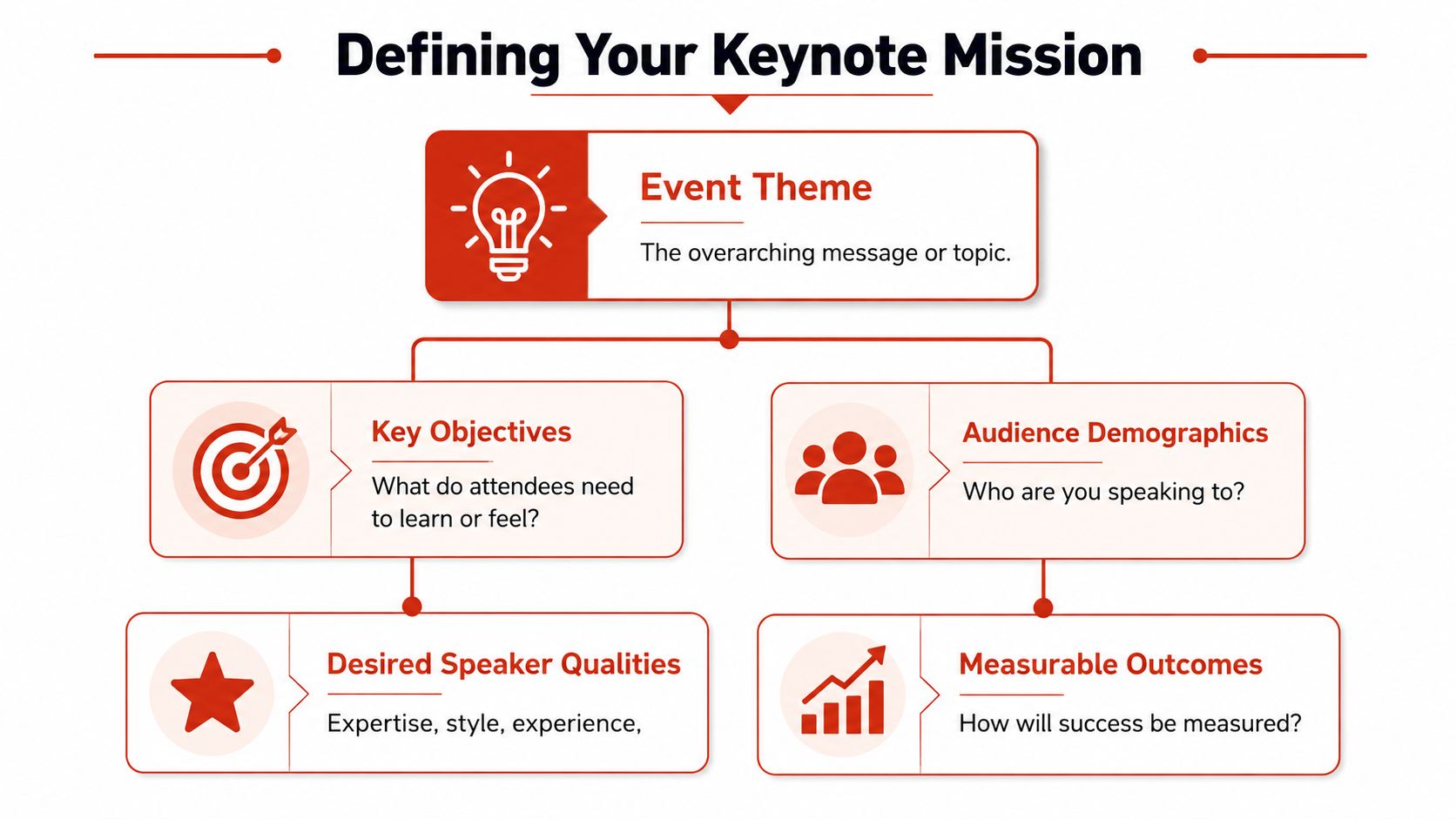
Define what the session must accomplish before you look at a single profile. "Leadership" is a theme. "Give our regional managers a framework for leading through a restructure without creating confusion downstream" is a mission. The second version produces a usable shortlist. The first produces a wall of options.
Know where to look
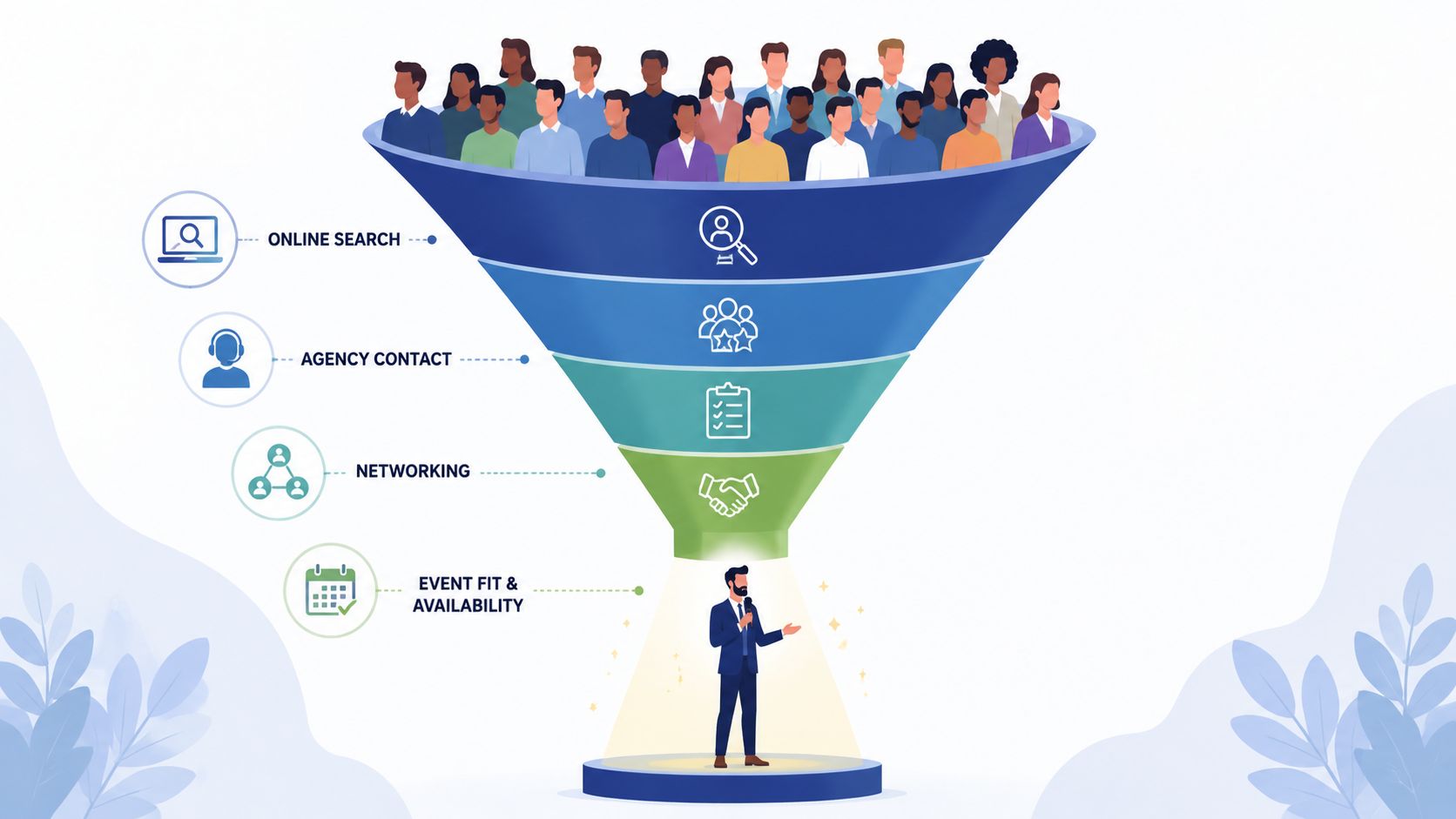
There are four main channels for finding keynote speakers:
- Referrals from peers. Ask event planners at companies similar to yours. If they booked a speaker for a sales kickoff that worked, the recommendation is already pre-vetted. This is still the highest-signal source.
- Online search. A 2024 study found that 56% of business leaders who booked AI speakers found them through online research. Search is fast, but it surfaces marketing — you're still doing the vetting work yourself.
- Speaker aggregators. Sites that list thousands of speakers give you volume. Useful for early browsing, but not curation. The evaluation work stays with you.
- Curated speaker bureaus. A bureau narrows the field and translates your mission into candidate fit. At Silicon Valley Speakers Bureau, we keep a focused roster rather than a database of 10,000 names — which means fewer but more relevant options. We also handle fee negotiation, contracts, and logistics, so the booking process doesn't add overhead to your plate.
What to look for when reviewing profiles
When you're reviewing a speaker site or profile, look for evidence, not just marketing:
- Topic precision. Does the speaker describe specific business problems they address, or just broad themes?
- Audience fit. Do they speak to executives, revenue teams, technical audiences, or mixed groups?
- Stage evidence. Is there footage of a real keynote — not just a brand reel?
- Customization signals. Do they adapt to company goals, or deliver one fixed talk everywhere?
Watch a full recording, not just highlights. Highlight reels are designed to create interest. A full keynote tells you whether the speaker can sustain an argument for 45 minutes.
Build a shortlist of 3 to 5
That's usually enough range without turning the decision into an internal debate about taste. A good shortlist has variety but not randomness: one safe fit, one stronger storyteller, one with deeper technical or operational credibility. When those profiles are well chosen, the selection conversation becomes sharper — you're comparing fit, not arguing over fame.
If you want context on fees before shortlisting, this overview of keynote speaker prices helps frame the market without forcing every candidate into the same bucket.
What does a keynote business speaker cost?
Fees vary more than most planners expect. Here's a rough breakdown of where the market sits in 2026:
- $5,000–$15,000: Emerging speakers, strong regional profiles, academics with sharp domain expertise. Good for tighter budgets where content fit matters more than name recognition.
- $15,000–$40,000: Established keynote speakers with a consistent body of work, proven stage presence, and recognizable client lists. This range covers most corporate events.
- $40,000–$100,000+: Authors on the bestseller list, former CEOs, prominent technologists, and speakers with national or global name recognition. Justified when the name itself is part of the event strategy.
These ranges don't include travel, which can add $2,000–$8,000 depending on origin and class requirements. A bureau typically works on commission, so you're not paying a separate booking fee — the bureau earns from the speaker's side of the agreement.
The bigger budget mistake isn't overspending. It's overspending on the wrong speaker. A $75,000 booking that doesn't fit the room costs more than a $20,000 speaker who delivers exactly what the moment needed.
Keynote speakers for business events: matching speaker to event type
The same speaker who opens a tech conference beautifully may be wrong for a sales kickoff. Event format shapes the brief as much as topic does.
Here's how the logic shifts by event type:
- Sales kickoffs. Look for someone who creates urgency, sharpens message discipline, and gives reps language they can carry into the next customer call. High energy alone isn't the brief — behavior change after the meeting is.
- Leadership retreats. Prioritize a speaker who delivers a framework leaders can use across teams, not just a story they admire in the room. Frameworks travel; inspiration fades.
- Customer conferences. Favor external credibility and market insight that strengthens your positioning with buyers and partners. The speaker is an extension of your brand that day.
- Annual conferences and association events. Broader audiences need speakers who can reach multiple roles at once — the engineer, the finance lead, and the VP of marketing in the same 45 minutes.
- Employee appreciation and company milestones. Motivational speakers and high-performance athletes are well-suited here. The brief is energy and shared experience, not strategic frameworks.
Trade-offs matter. A celebrity founder may help with attendance and internal excitement, but a less famous operator often delivers more value to a technical or leadership audience. The better choice is always the person whose material fits the room, the moment, and the decision your audience has to make next.
Keynote speaker for a tech company all-hands meeting
All-hands meetings are a distinct format — and the wrong speaker choice is obvious fast. You're not educating an external audience. You're talking to your own people, who already know the company, can spot a generic talk immediately, and have a high tolerance for wasted time.
The all-hands keynote has to do several things at once: reach the engineer and the recruiter and the finance analyst in the same 50 minutes, connect to what the company is actually going through right now, and leave people with something concrete they can act on Tuesday morning.
What to look for in an all-hands speaker
- Customization depth. The talk should address your company's current moment — a growth phase, a restructure, a product pivot. Generic inspiration doesn't land with internal audiences who know the real situation.
- Frameworks, not just stories. A framework with a name travels through a company long after the meeting ends. Applause lines don't. Ask the speaker: what do you want people to do differently the week after this?
- Substance over motivation. Technical and product teams respond to real arguments supported by evidence — not keynote energy without content behind it.
A visionary founder like Adam Cheyer, known for creating Siri, works well at innovation or AI all-hands events where the audience wants a firsthand account of how breakthrough products get imagined and built. That profile may be too conceptual for a sales audience that needs direct translation into customer conversations.
A performance speaker like Shannon Rowbury connects well with audiences that need discipline, resilience, and practical lessons around execution under pressure — a common need at sales or ops all-hands meetings.
Some companies combine a futurist opener with a leadership closer: one speaker contextualizes the industry moment, the other connects it to what the team needs to do next. When the pairing is intentional, it's more effective than a single session trying to do both.
What industries hire keynote business speakers?
Almost every industry runs events where keynote speakers play a role — but the brief, the budget, and the speaker profile that works varies a lot by sector.
- Technology companies. The most active market. Tech companies hire keynote speakers for sales kickoffs, engineering offsites, product launches, customer summits, and leadership retreats. AI, innovation, and leadership are the dominant topic areas. Budget tolerance is typically higher than other sectors.
- Financial services and banking. Speakers on leadership, organizational resilience, and technology transformation are common. Regulatory and trust themes surface at compliance-heavy events.
- Healthcare and biotech. Life science companies hire speakers for annual conferences, leadership summits, and team-building events. Scientific credibility matters as much as stage presence.
- Professional services (consulting, law, accounting). These firms run large annual partner meetings and client events. The bar for intellectual rigor is high.
- Associations and trade groups. Annual conferences drive most of the speaker spend here. A strong opening keynote can define the event's reputation for the year.
- Retail and consumer brands. Franchise meetings, national sales conferences, and customer appreciation events. Energy and brand alignment are often as important as content depth.
- Manufacturing and logistics. Leadership and operational excellence themes are common. Safety and culture keynotes appear regularly in this sector.
At Silicon Valley Speakers Bureau, most of our clients are corporate event planners at Fortune 500 companies, fast-growing tech companies, and associations running flagship annual events. The common thread is that the event matters — the keynote isn't filler, it's load-bearing.
Evaluating and booking your speaker
Once you have a shortlist, the evaluation process has three pillars: content alignment, delivery fit, and verifiable credibility.
Content alignment comes first
Domain depth is the strongest signal of quality. Look for topic depth that is visible and specific — for a founder, that's the record of building a product or company; for an operator, it's years of implementation experience; for an elite performer, it's a proven system tied to execution.
A few useful questions on content:
- Does this person solve the exact problem we defined?
- Can they speak at the right altitude for this room?
- Will attendees leave with language or frameworks they can use?
Delivery fit is not the same as energy
Event teams often over-index on "high energy" because it feels safe. But delivery fit is more specific than that. Watch for pacing, audience interaction, humor style, and complexity level. A speaker can be brilliant and still be wrong for a cautious executive audience or a highly technical internal summit.
The right speaker doesn't just hold attention. They hold the right kind of attention.
Questions worth asking on the intro call
Don't use the call to review a biography. Use it to test judgment.
- What would you want to know about our audience before shaping this keynote?
- What kinds of events are the best fit for your message — and where are you not the right fit?
- How do you tailor the talk for executive, sales, or technical audiences?
- What do you want people to do differently after hearing you?
- Can you support reinforcement after the event if needed?
Weak candidates give generic answers. Strong candidates diagnose before they pitch.
The booking agreement
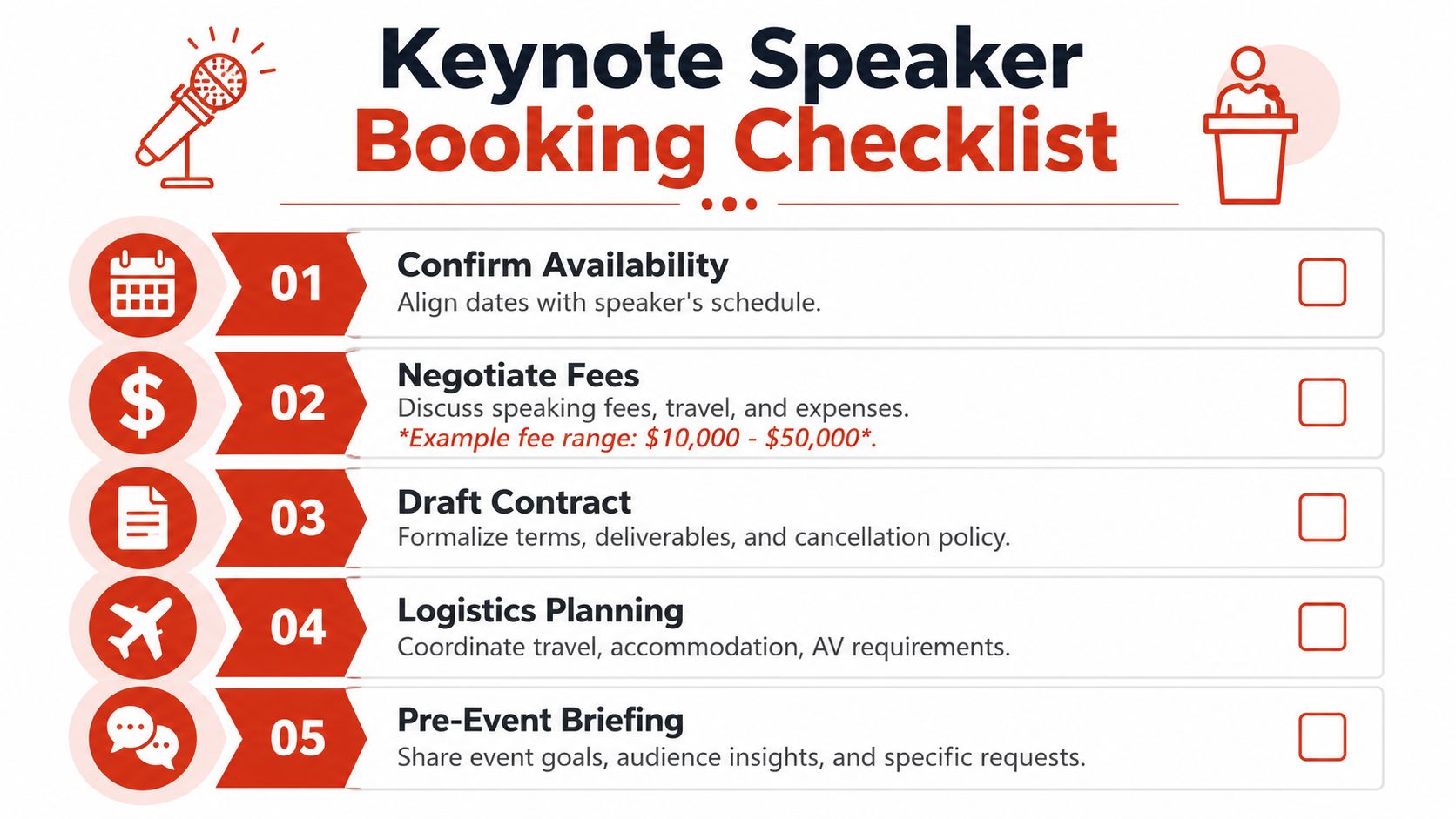
Once selected, the contract phase starts. Many planners treat this as paperwork. It isn't. A strong speaker agreement removes friction by answering the questions that create last-minute problems: scope (keynote only or fireside/workshop too), timing, travel, recording rights, payment schedule, and cancellation terms.
Booking is not the administrative end of the process. It's the operational beginning.
Before the event: setting the speaker up to succeed
A booked speaker can still fail if the runway is bad. Most keynote problems don't start on stage — they start in the weeks before, when assumptions replace preparation.
Give the speaker the same situational awareness your internal leaders have. Share the current business context (recent wins, setbacks, change initiatives), the audience temperature (excited, skeptical, tired), and any language to use or avoid. The strongest keynotes often come from one good briefing call where the speaker hears what's actually happening inside the organization.
On the logistics side: run a real AV check covering slides, clicker, timer, confidence monitor, audio, and video playback. Lock down recording rights before the event. Document any special requests — panel moderation, attendee meetups, sponsor touchpoints — so they don't live only in email threads.
And prepare the audience, not just the stage. A short internal note explaining why this speaker was chosen and what attendees should listen for makes a meaningful difference in how the room receives the session.
Measuring what the keynote actually produced
The room gave a standing ovation. The CEO was pleased. Two weeks later, the sales team was back to old habits, no one could show what changed, and the budget line was hard to justify next year.
That's the gap to close. If the keynote was booked to drive a business outcome, measure it against that outcome.
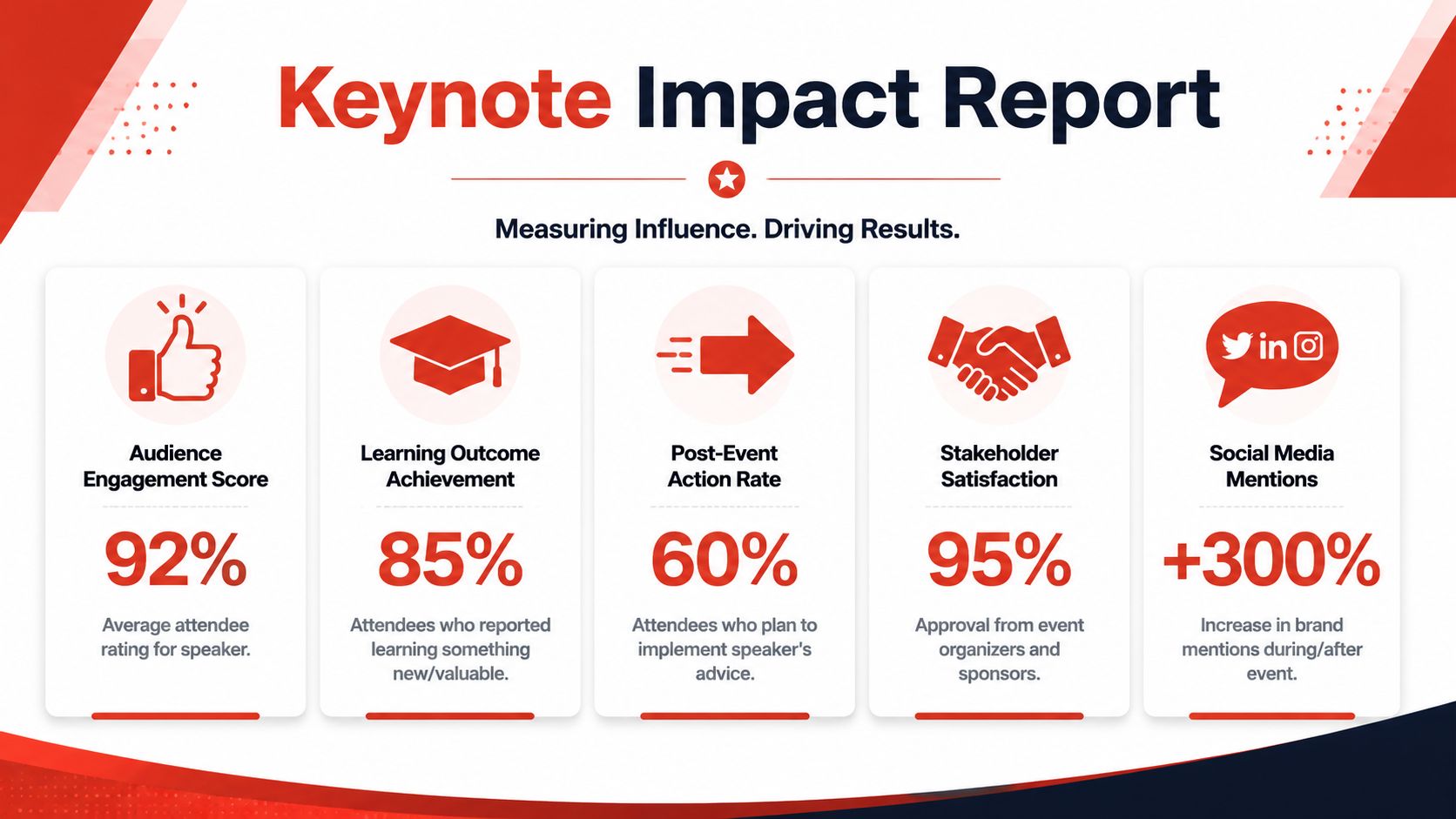
Use three layers of signals:
- In-room signals: attendance, attention, Q&A volume, poll participation, quality of audience questions
- Transfer signals: references in later sessions, manager follow-up, recap usage, action commitments
- Business signals: sponsor response, lead quality at customer events, leadership alignment, signs that teams are applying the ideas in operations
A high satisfaction score can still mask a poor fit if the talk was inspiring but too generic to use on Monday morning. The keynote earns its budget twice — first in the room, then in the evidence that it changed something.
Frequently asked questions
How far in advance should I book a keynote business speaker?
For top-tier speakers, six to nine months is the norm. Speakers with strong demand book a year out for flagship events. If you're inside 90 days, you're not out of options — but your shortlist will be narrower. A bureau can often move faster because they know which speakers have calendar gaps.
How do I find a keynote speaker on a tight budget?
Define your mission precisely first — that narrows the field fast. Emerging speakers in the $5,000–$15,000 range can deliver strong results when the brief is clear. Academic researchers, rising executives, and practitioners with deep domain expertise often outperform famous names at this budget level. A bureau can also negotiate rates and identify speakers open to lower fees for events that fit their positioning.
What's the difference between a speaker bureau and a speaker agency?
In practice, both connect planners with speakers. The difference is usually in model and curation. Aggregator-style agencies list thousands of speakers and let you browse. Curated bureaus like Silicon Valley Speakers Bureau maintain a focused roster, make a recommendation based on your brief, and manage the relationship through booking. The curated model saves time and tends to produce better matches when the event is high-stakes.
Can a keynote speaker customize their talk for our company?
Most professional keynote speakers offer some customization — references to your company, industry examples, adjusted framing. The degree varies. Some speakers run a fixed talk with light customization; others do a full intake process and rebuild around your brief. Ask directly: what does your customization process look like, and what do you need from us to do it well? The answer tells you a lot about how they work.
What industries hire keynote business speakers most often?
Technology companies are the most active market. Financial services, healthcare, professional services, and associations are also major buyers. The common thread isn't industry — it's that the event matters enough to have a keynote at all. Companies hire keynote speakers when they need the room to walk out with a shared idea, not just a shared experience.
How do speaker bureaus charge?
Speaker bureaus typically earn a commission from the speaker's fee rather than charging the client a separate fee. That means working with a bureau usually costs the same as or close to going direct. The value is in curation, negotiation, contract management, and logistics support — not a markup on the fee.
What makes a keynote speaker right for a tech company all-hands?
Three things: customization depth (the talk should reference your company's current reality, not a generic frame), substantive frameworks (technical audiences don't respond to applause lines without content behind them), and a credibility profile that makes sense to the room. A founder who built something real carries more weight with an engineering audience than a motivational speaker with a polished reel. The ideal all-hands speaker gives people something they'll still be referencing at the next team meeting.
If you're planning an event and want help matching the moment to the right speaker, browse the Silicon Valley Speakers Bureau roster or reach out directly. We work with event planners at Fortune 500 companies, fast-growing tech companies, and associations booking keynotes for sales kickoffs, leadership retreats, customer conferences, and company-wide meetings.